A Southside Virginia man.
The exact wording appears in the proceedings of the Treaty of Albany (1722) between Virginia (represented by Governor Alexander Spotswood) and the Five Nations (Iroquois Confederacy). During negotiations, the Iroquois deputies acknowledged robbing and harming Captain Robert Hicks during a raid in the Tuscarora War era (around 1711–1713), where they plundered his trading caravan, killed associates/horses, and took goods. They referred to him as “that honest man Captn Hicks” and promised eventual reparation, though they claimed limited ability at the time due to losses from a forest fire.
This is documented in:
- The Virginia Magazine of History and Biography, Vol. 13 (1905), in the article “The Early Westward Movement of Virginia, 1722-1734. As Shown by the Proceedings of the Colonial Council” (pp. 1–37, specifically around pp. 16–17 and notes). The full text is available via Internet Archive or JSTOR (stable URL: https://www.jstor.org/stable/4242720).
- Cross-referenced in treaty transcripts, such as in the Tribal Treaties Database entry for the Great Treaty of 1722 treaties.okstate.edu, which includes the Iroquois’ response: “as to that honest man Captn Hicks we own our people did rob him of a very considerable booty…”
https://treaties.okstate.edu/treaties/great-treaty-of-1722-21770
The fullest biographical treatment using this phrase as a chapter title is in the book:
- Historical and Biographical Sketches of Greensville County, Virginia, 1650-1967 (published by The Riparian Woman’s Club, Emporia, VA; first ed. ~1968, second ed. 1968–2000).
- Chapter II: “That Honest Man, Captain Hicks” (divided into Parts I, II, and sometimes III), written/edited by Douglas Summers Brown (and contributors like Virginia Lee Baker, Eleanor Little Eanes).
- This chapter covers Hicks’ life as an Indian trader (licensed ~1712 with partners), his role in negotiations with tribes like the Saponi, Nottoway, and others, his family, land holdings (e.g., at Hicks’ Ford on the Meherrin River), and his reputation for fairness in dealings.
Apparently, in 1693, as noted in the Charles City County, Virginia, court orders 1687-1695, noted on page 456 (in the original) and transcribed on page 154 (in the online book)…“Robert Hix, appearing drunk in court, is committed to the stocks”. So there is that… But as a drinking man myself, and having a fondness for horse thieves and women of ill repute, I do not hold that against him overmuch.
But as a historical note, a brief quote from: Further Answer of ye five Nations to His Excellency Alex: Spotswood Esqre Governor of Virginia. in Albany 12 Septr 1722
PRESENT—His Excellency Alex: Spotswood Esqre Governor of Virginia
Coll Nathaniel Harrison one of His Matys Council of Virginia
Coll William Robinson a Member of the assembly of Burgesses of Virginia
Commissioners of the Indian Affairs
Coll Peter Schuyler
Peter V Brugh
Hendr Hanse
Ph: Livingston
Johs Cuyler
John Collins
Johs Bleeker
[quoting]. Brother Assarigoe
You told us yesterday that you would not sum up any of our former Misdeeds but would forgive all that is passed We acknowledge our People have been guilty of a great many bad actions & heartily thank you that you are so good as to forgive them & as to that honest man Captn Hicks we own our people did rob him of a very considerable booty & did him a great deal of Mischeif, but by an accident that befel us afterwards it happened we got very little by it for the woods being very dry by the negligence of some of our own people took fire & thereby we lost the most part of what we had taken: Nevertheless when we are able we do promise to make that poor man some reparation for his loss, but at this juncture we are not in a capacity of doing it We have now made a Peace with you & we hope it will be kept by us & our Children’s Children for ever & thereupon we give a Belt
Much, if not all, of that rich history (writ Large), has come down today (in my recollections since childhood) as: “Indian Giving”. Since the Indegenes never had much to give, other than skins and such, I think it refers to treaties, regardless of all the pomp and circumstance.
I propose to map the various holdings of Capt Hicks in my Southside Map as time and circumstances permit…
I found him lurking about here in 1702 which has piqued my curiosity as to what the hell he was doing there… I know not if he was drunk or not?
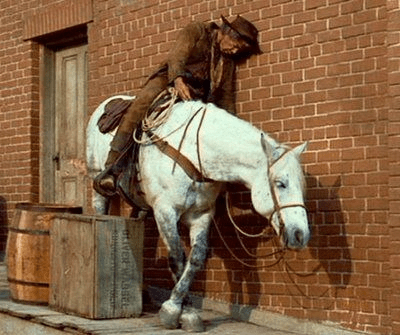
Actor Lee Marvin’s horse in Cat Ballou (1965), Smoky, won a Craven Award in 1966 for his excellent animal “acting.” The Craven Award was named after Richard C. Craven, the first director of the American Humane Association of Hollywood, and is given to animals who demonstrate their skills in supporting roles.
 Colonial Southside Virginia... a Blog and Maps
Leave a comment